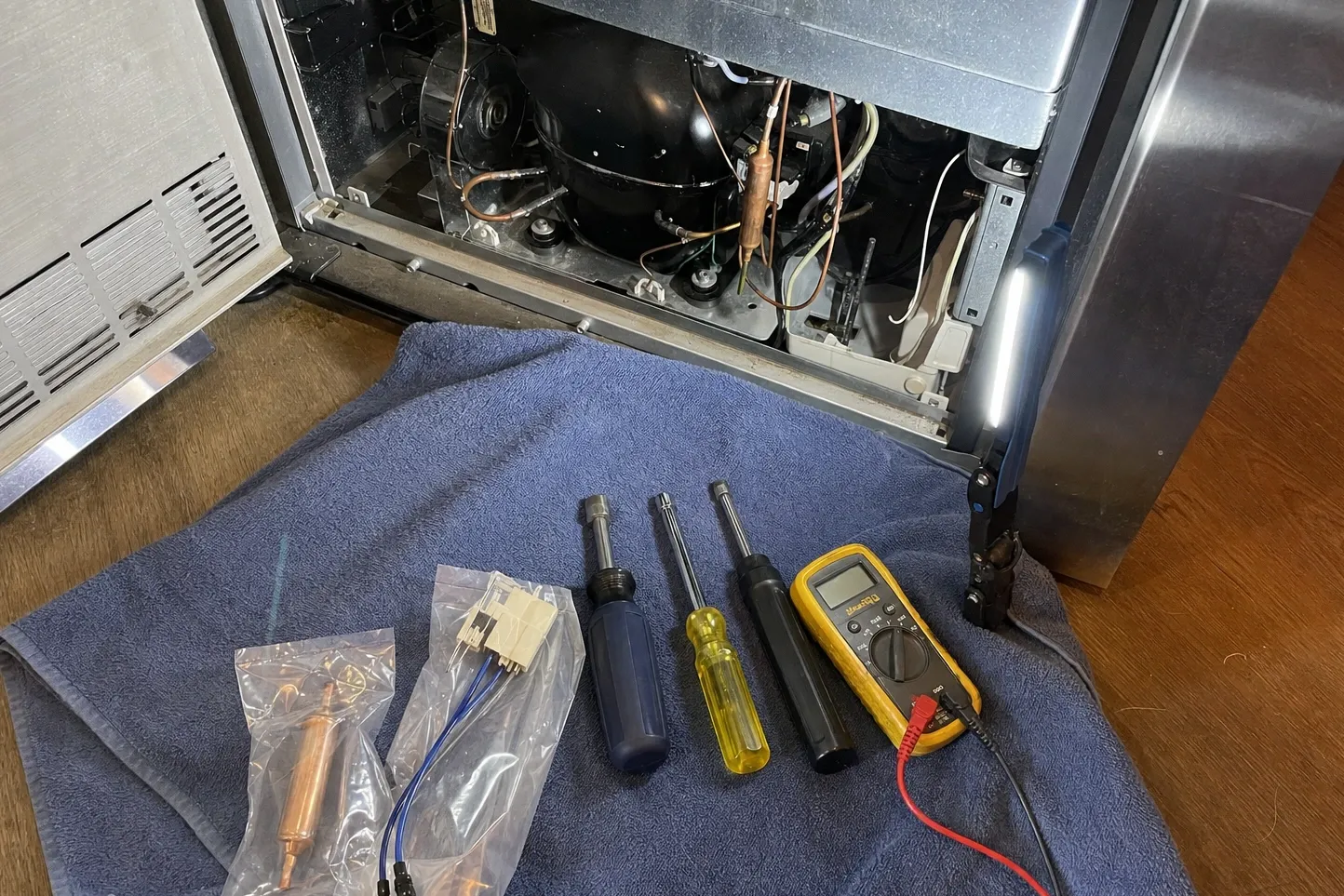
Wine Storage Repair
Wine Zones Reading the Same Number: What Has Gone Wrong
Written by
Yuki Tanabe
Refrigeration technician — controls and sensors · 18 years in the trade
Tests a sensor against an independent reading rather than trusting the display it feeds. Drift is quiet, cheap to correct, and routinely mistaken for a dying compressor.
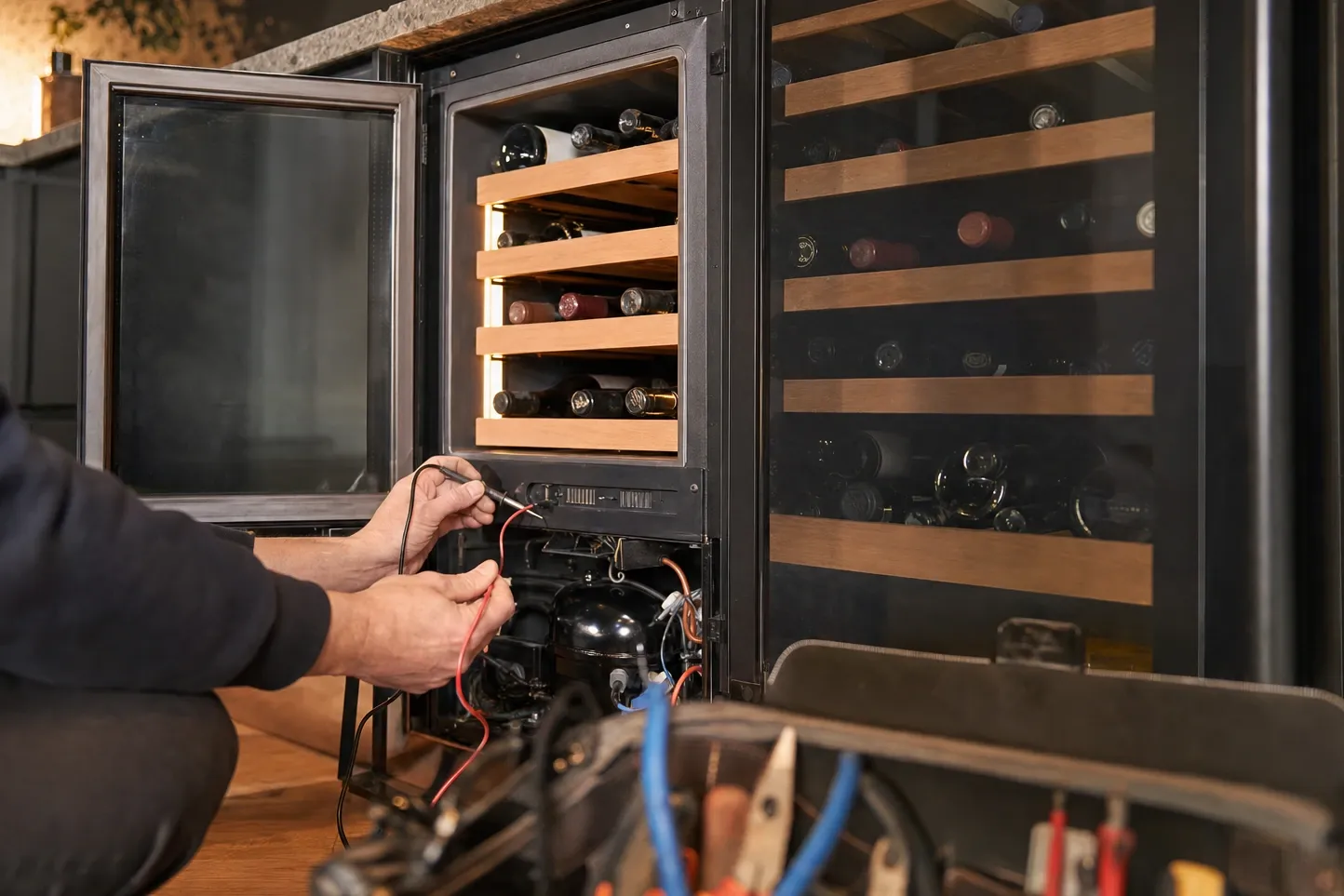
Wine storage fails politely. A refrigerator that stops cooling gets noticed within hours, but a wine column whose two zones have quietly merged into one temperature can run that way for a month before anyone puts a thermometer in it. Usually it is spotted when someone sets the upper zone lower, the display accepts the number, and nothing at all happens.
The cabinet is not ignoring you. In almost every case one specific part of the zoning system has stopped working, and which part it is can be narrowed down before anyone opens anything.
What a dual-zone cabinet is actually doing
Most integrated and undercounter wine columns do not run two cooling systems. They run one evaporator and split the cold air between two compartments, usually with a motorised damper, and each compartment has its own temperature sensor reporting back to the control board.
That architecture matters for the diagnosis. If a single evaporator feeds both zones and the split stops happening, both compartments end up at whatever temperature the one that is still being controlled asks for. The other zone simply gets whatever it gets — which is why the failure shows up as two identical readings rather than as one zone going warm on its own.
Some larger columns do have two circuits and behave differently: there, a failed zone drifts towards room temperature instead of settling next to its neighbour. If your warm zone is climbing well past cellar range rather than sitting a couple of degrees off, that is the pattern you have.
The three faults behind one temperature
In rough order of how often they turn up:
- A stuck damper. The motor or the flap that divides the airflow has jammed, usually open. Both compartments then see the same air, so both read the same number. It is the most common cause and one of the cheaper repairs.
- A dead zone sensor. If the board cannot read a compartment, it stops trying to control it and falls back on the zone it can see. The display often keeps showing a plausible number, which is what makes this one deceptive.
- A lost board circuit. Less common, and usually the diagnosis after the first two have been ruled out. The zone stops responding to the control entirely, and the interior light or the fan on that side sometimes goes with it.
Underneath all three there is a fourth possibility worth mentioning, because it is the one that costs money if it is missed: a cabinet that cannot hold either zone because the sealed system is short of refrigerant. That reads differently — both zones drift up together rather than settling at one correct-ish number — but on a warm afternoon the two can look similar for an hour.
Condensation on the glass is a separate problem
Beading on the inside of a glass door often arrives at the same time as a zone fault and gets reported as part of it. It is usually its own repair.
Glass-door units have an anti-condensation heater in the door frame, and when it fails the glass sweats whenever the room is humid. On this side of the city, in the months when the marine layer sits in until mid-morning, that means most days. The other cause is a door seal that has gone slack along the bottom edge, letting humid room air in at the base of the cabinet where it immediately hits cold glass.
Neither is dangerous to the wine, but both are worth fixing: a seal that no longer compresses is also making the compressor work longer than it needs to, and labels do not enjoy repeated damp.
What you can check before booking
Two things, and both are worth doing because they change what the visit starts with.
Put a real thermometer on a shelf in each zone. Not against the back wall and not on the glass — mid-depth, mid-height, ideally in a glass of water so it reads an average rather than every door opening. Leave it four hours and write both numbers down alongside what each zone is set to. Four numbers, and the fault is already half described.
Listen at the divider between the zones with the door just opened. On a damper-equipped cabinet you can often hear the flap move within a minute or two of changing a setpoint by several degrees. Nothing moving at all, on a cabinet that used to hold two different temperatures, is a strong pointer.
What is not worth doing: leaving the cabinet unplugged overnight to reset it. It does nothing for a stuck damper or a dead sensor, and on a unit that is already warm it costs you the only thing you had — a stable temperature.
When the sealed system is the answer
If both zones are reading the same number and that number is well above either setpoint, the zoning system may be a red herring. A cabinet that has lost part of its charge, or has a condenser boxed into cabinetry with no air to draw on, cannot hold cellar temperature in either compartment, and the merged reading is a symptom of insufficient capacity rather than of a failed split.
That distinction is made with gauges and a current reading at the compressor, not by looking at the display. It is also where the honest answer sometimes turns out to be that a small undercounter unit is not worth a sealed-system repair — and on a column full of bottles it almost always is.
Either way the visit begins the same way: a probe on a shelf in each zone, the setpoints noted, the damper and sensors tested, and the readings shown to you rather than summarised.
Follow-ups
- Is my wine ruined if one zone ran warm for a few weeks?
- Almost certainly not. Steady storage a few degrees above ideal is far less damaging than repeated swings, and a few weeks at the wrong end of the range is survivable for most bottles. What does real harm is a compartment cycling ten degrees up and down, or one that has been sitting near room temperature for months.
- Can I keep using the cabinet while I wait for the repair?
- Yes. If one zone is holding correctly, move anything you care about into it. If both zones have settled on a single temperature that is somewhere in the cellar range, the bottles are fine where they are until someone looks at it.
- The bottom zone is warmer than the top. Is that backwards?
- No. On most dual-zone columns the lower compartment is the warmer one, because it is furthest from the evaporator feed. What matters is whether each zone is holding what its own setpoint asks for, not which one is colder.